
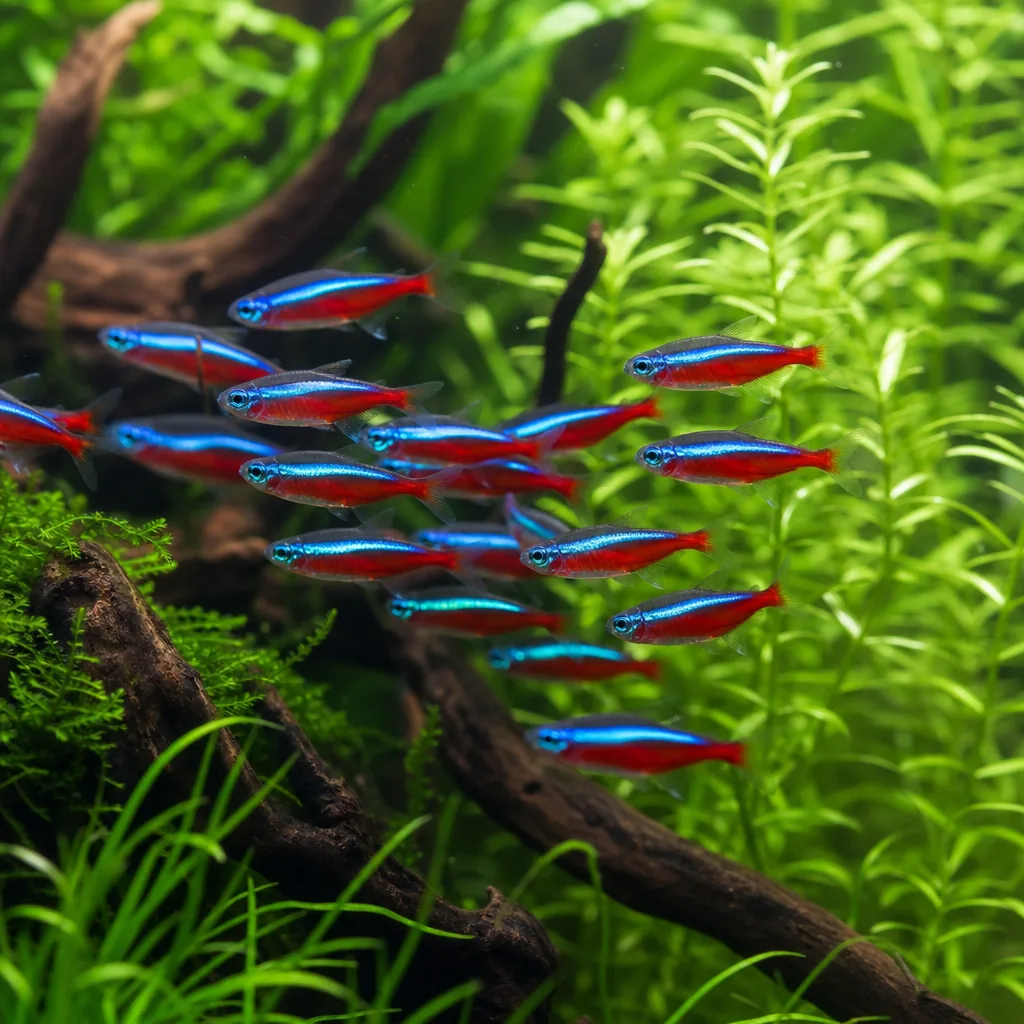
A 20-gallon aquarium is a sweet spot for many hobbyists. It holds enough water to stay stable, fits on most sturdy furniture, and gives you room for a school of small fish plus a few bottom dwellers. The key is choosing fish that stay small, get along, and suit the tank’s shape.
20 high vs 20 long
Both hold about 20 gallons, but the shape matters:
- 20 high: about 24 inches long and taller. Good for showing off plants and mid-water fish.
- 20 long: about 30 inches long and shallower. Gives active swimmers and bottom dwellers more floor space and makes a better choice for schools.
If you’re still choosing, the 20 long is usually the more flexible stocking option.
Good fish for a 20-gallon tank
Small schooling fish (pick one or two species, groups of 6 to 10)
- Neon or cardinal tetras
- Ember tetras
- Harlequin rasboras
- Chili rasboras, for a very small, delicate school
- Celestial pearl danios
Bottom dwellers (groups of 6)
- Pygmy, panda or bronze corydoras. Use sand or smooth gravel to protect their barbels.
- Kuhli loaches, which hide during the day and need soft substrate
Centerpiece fish (choose one)
- Honey gourami, a peaceful, colorful option
- Dwarf gourami, best kept one per tank
- A male betta, only with calm, short-finned tank mates
- A small group of female guppies or endlers for color
Cleanup helpers
- Otocinclus, in a group, once the tank has mature algae growth
- Nerite snails
- Cherry or amano shrimp, though larger fish may eat baby shrimp
Sample stockings
Classic community: 10 neon tetras, 6 panda corydoras, 1 honey gourami, 2 nerite snails.
Nano school showcase: 12 ember tetras, 8 chili rasboras, 6 pygmy corydoras, a colony of cherry shrimp.
Betta centerpiece: 1 male betta, 8 harlequin rasboras, 6 kuhli loaches, a few nerite snails.
These are starting points. Filtration, plants and how well you keep up with maintenance all affect how many fish a tank can carry. Our stocking guide explains how to judge it.
Fish to avoid in 20 gallons
- Goldfish. Even fancy goldfish grow large and produce lots of waste.
- Common plecos. They can reach well over a foot.
- Bala sharks and silver dollars. Large, active schooling fish that need far more room.
- Angelfish. They grow tall and may eat small tetras.
- Tiger barbs. Often nippy, and they need a big group to stay civil.
- Most cichlids other than a few dwarf species like rams or apistogramma, and even those need careful planning.
Add fish slowly
Start only after the tank has completed its nitrogen cycle. Add a small group first, such as the schooling fish, and wait a couple of weeks while testing ammonia and nitrite before the next group. Quarantining new arrivals is worth doing, and our quarantine tank guide explains how.
Water and setup tips
- Most of the fish above do well around 74 to 78°F with a pH near neutral. Check each species, since some, like celestial pearl danios, prefer slightly cooler water.
- Use a filter rated for at least 20 gallons. A slightly oversized hang-on-back or a sponge filter works well.
- Live plants and wood give shy fish cover and make schools feel safe enough to come out.
- Change around 25% of the water weekly.
Plants, hardscape and filtration for a 20
A well-planted 20-gallon tank supports fish better than a bare one. Easy plants like java fern, anubias, cryptocorynes and a few stem plants soak up waste and give schooling fish a sense of security. A piece or two of driftwood adds caves for corydoras and loaches. Leave an open swimming lane along the front so tetras and rasboras have room to school. For filtration, a hang-on-back rated for 20 to 30 gallons is the most common choice. A sponge filter is gentle and great with shrimp or tiny fish, and many keepers run both for extra capacity and a backup. Whatever you choose, keep the outflow moderate, since most of the small species listed here come from slow-moving water and don’t enjoy strong current.
Lighting doesn’t need to be fancy. A basic LED on a 6 to 8 hour timer keeps easy plants growing and fish colors looking good without inviting algae.
Matching fish to your water
Before choosing species, find out what comes out of your tap. Hardness and pH vary a lot by region, and many popular small fish do best within a fairly narrow range. Soft, slightly acidic water suits many tetras, rasboras, and dwarf cichlids. Harder, more alkaline water suits livebearers like platies and endlers. Choosing fish that already fit your water is far easier than trying to adjust chemistry every week. A quick test with a liquid kit, or a call to your water utility, gives you a starting point.
Temperature matters too. Most tropical community fish are comfortable between roughly 74 and 78°F, but a few common choices prefer cooler or warmer water. White cloud mountain minnows like it cooler, while some gouramis and rams prefer it warmer. Keep everyone in the tank within an overlapping range.
Using every level of the tank
A 20 gallon tank feels larger when its fish spread out vertically. Hatchetfish and some killifish stay near the surface. Most tetras and rasboras cruise the middle. Corydoras, kuhli loaches, and small plecos search the bottom. Picking one group for each level, instead of several species that all crowd the middle, gives each fish room and makes the tank look busier without adding many more bodies. Note that a standard 20 gallon is taller than a 20 long, which has more floor space and suits bottom dwellers and active schooling fish better.
Adding fish in stages
Even in a cycled tank, add fish in two or three rounds spaced a week or two apart. Bottom dwellers and the calmest species can go in first, with the more confident fish last so they do not claim the whole tank before others settle. Test ammonia and nitrite a few days after each addition. If either shows up, slow down and do a partial water change before adding more.
Wrap-up
Choose small, peaceful species, keep schools in proper groups, add one centerpiece fish at most, and stock slowly. For compatibility details, see community tank mates, neon tetra care and corydoras care, or shop for setup gear at the AquaticRig shop.
For a 20 gallon community: the Tetra 20 gallon tank, the Penguin 200 filter, and a staple like TetraColor flakes.
Frequently Asked Questions
How many fish can go in a 20-gallon tank?
It depends on the species, but a typical community might hold around 15 to 25 very small fish. The one-inch-per-gallon rule is a rough guide and doesn’t account for body shape or waste.
Can I keep a betta in a 20-gallon community?
Often, yes. Avoid fin nippers and other long-finned fish, and have a backup plan in case your betta turns out to be aggressive.
Are shrimp safe with these fish?
Adult cherry shrimp usually do fine with tiny fish like ember tetras, but most fish will eat baby shrimp. Plenty of plants and moss helps a colony survive.
Is a 20-gallon tank good for beginners?
Yes. It’s stable enough to be forgiving while still small enough to maintain easily.
This article was researched and written with AI assistance and reviewed for accuracy.