
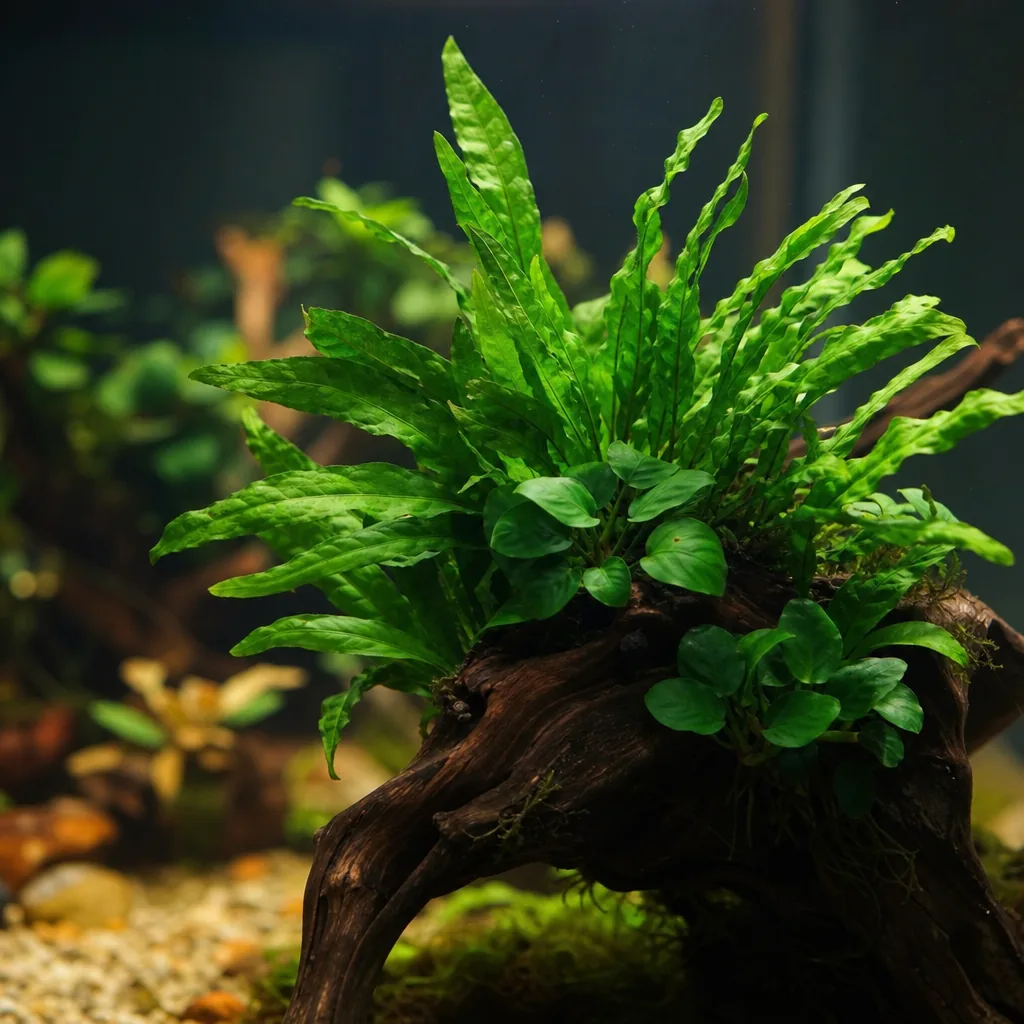
Anubias is a slow-growing plant from West and Central Africa, where it grows along riverbanks with its roots clinging to rocks and wood. That background is why it does so well in home aquariums. It tolerates low light, it isn’t fussy about water, and its thick, leathery leaves hold up to fish that would shred softer plants. Most problems come from treating it like a regular stem or rooted plant.
Know the rhizome
Anubias grows from a rhizome, a thick horizontal stem that the leaves and roots grow out of. The rhizome needs to stay exposed to water. Bury it in gravel or sand and it can rot, leaves turn yellow, and the plant slowly dies. The roots can go into the substrate, but the rhizome itself should sit on top.
When you buy a potted anubias, remove the pot and gently pull away the rock wool. Rinse the roots, and trim any that are mushy or brown.
How to attach it
The easiest place for anubias is on hardscape. A few good options:
- Tie it on. Wrap cotton thread or fishing line around the rhizome and a piece of driftwood or rock. The roots will grip within a few weeks, and you can remove the fishing line then.
- Glue it. A small dot of cyanoacrylate super glue gel holds the rhizome in place. It sets quickly and is safe once cured. Dry the spot first and use only a little.
- Wedge it. Slide the rhizome into a gap between rocks or wood so it’s held securely without being covered.
- Plant shallowly. If you want it in the substrate, place the roots under the gravel and leave the rhizome sitting on top.
Light
Anubias does well in low to moderate light. Under strong light the slow leaves collect algae faster than they grow, so in high-light tanks it’s best placed in the shade of taller plants or under an overhang. Around 6 to 8 hours of light per day is plenty. If your light has a timer, use it, as a consistent schedule helps keep algae down.
Water conditions
Anubias handles a broad range:
- Temperature: about 72 to 82°F (22 to 28°C)
- pH: roughly 6.0 to 7.5
- Hardness: soft to moderately hard
Steady conditions matter more than hitting an exact number. CO2 injection isn’t needed, but it will speed up growth a little if your tank has it.
Feeding the plant
Because anubias takes most of its nutrients from the water column through its leaves and roots, root tabs do little for a plant on wood. A light dose of an all-in-one liquid fertilizer once a week, or as directed on the bottle, is usually enough. In a tank with plenty of fish, fish waste may cover much of what it needs. See our comparison of root tabs and liquid fertilizers for more on the difference.
Popular varieties
- Anubias barteri var. nana: the most common. Compact, about 2 to 4 inches tall, and a classic for front or midground.
- Nana Petite: a miniature form with dime-sized leaves, perfect for nano tanks and small rocks.
- Anubias barteri: larger, with broad leaves that can reach 10 inches or more. Good for the background or for big wood.
- Coffeefolia: textured, rippled leaves with reddish new growth.
Common problems
Yellow leaves. An occasional yellow old leaf is normal, so just trim it. Many yellow leaves usually mean a buried rhizome, nutrient shortage, or a rotting section.
Algae on leaves. The leaves can last for years, which gives algae time to settle on them. Reduce light, keep water changes regular, and add some algae eaters such as nerite snails or otocinclus. Badly coated leaves can be trimmed off.
Rhizome rot. A soft, brown, bad-smelling part of the rhizome needs to go. Cut it away with clean scissors, leaving only firm green tissue, and make sure the rest sits above the substrate.
Melting after planting. Plants grown above water at farms sometimes lose a leaf or two as they adjust. As long as the rhizome stays firm, new submerged leaves will follow.
Propagating anubias
When the rhizome gets long, cut it into sections with sharp, clean scissors. Each section needs at least three or four leaves. Attach the new pieces the same way as the original. Growth is slow, often one new leaf every week or two, so patience is part of keeping this plant.
Good tank mates
The tough leaves make anubias a top choice for goldfish, cichlids and other fish that eat or uproot softer plants. Most plant-eating fish leave it alone. It also pairs well with aquarium moss and java fern, and appears on our list of low-light plants.
The short version
Keep the rhizome above the substrate, attach the plant to wood or rock, give it low to moderate light, and dose a light liquid fertilizer. Trim old leaves, watch for algae, and let it grow at its own pace. Browse the AquaticRig shop or more freshwater guides for help with the rest of the tank.
For anubias: Anubias barteri, the java fern and anubias bundle, spider wood to attach it to, and Seachem Flourish as a light liquid feed.
Frequently Asked Questions
Can anubias grow out of water?
Yes. It grows emersed in nature and in many farms, so it does well in paludariums and with leaves above the waterline, as long as the air is humid and the roots stay wet.
Why is my anubias growing so slowly?
That is normal. Even healthy anubias may only add a leaf every week or two. Low light and no CO2 slow it further, but that’s not a problem in itself.
Will fish eat anubias?
Rarely. Its leaves are tough and bitter, so even goldfish, African cichlids and silver dollars usually leave it alone.
Can I plant anubias in sand?
Yes, with the roots in the sand and the rhizome on top. Many keepers find it easier to attach it to hardscape instead.