
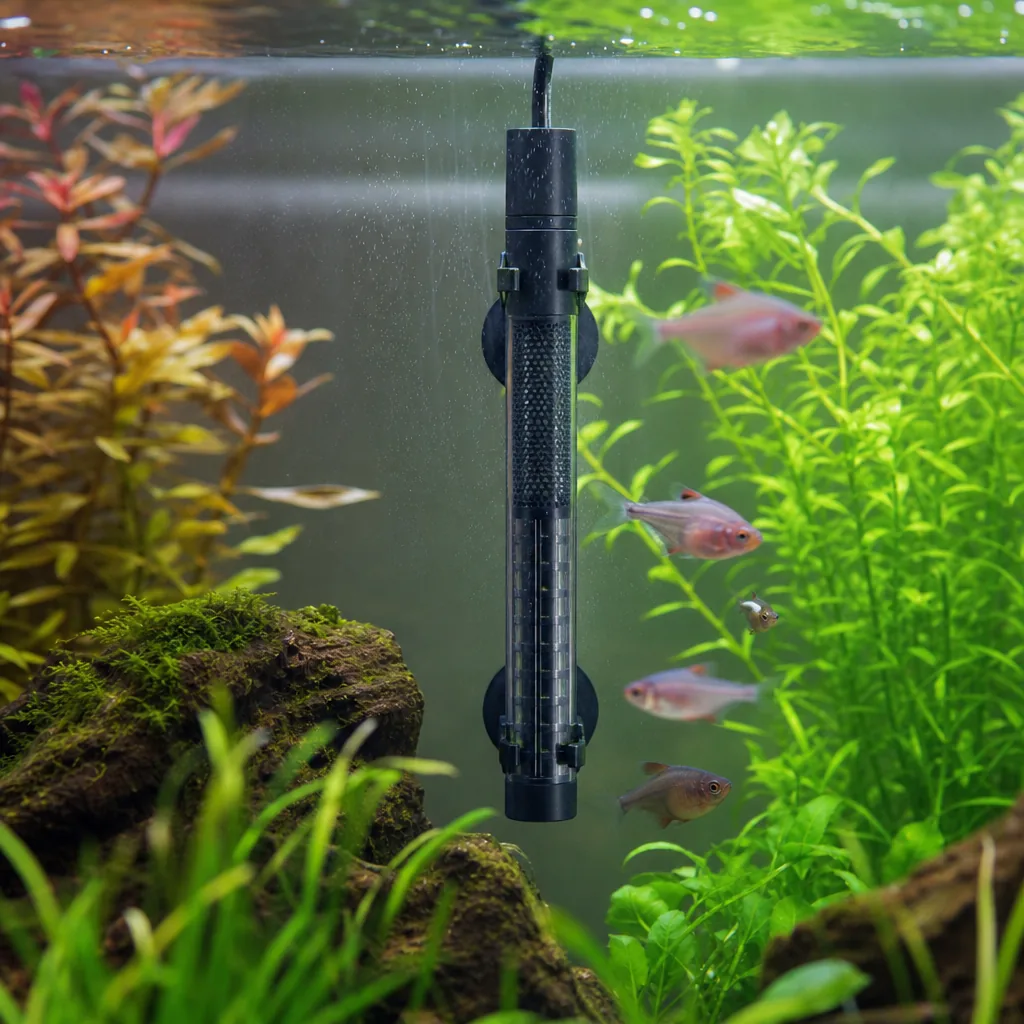
Fish are cold-blooded, so water temperature controls their metabolism, immune system and appetite. Even a dependable heater can stick on or fail, and a heater’s dial setting often doesn’t match the water. A separate thermometer is a cheap and simple way to know what’s actually happening in your tank.
Types of aquarium thermometers
Stick-on strips attach to the outside of the glass and change color to show temperature. They’re cheap and easy to read, but they measure glass temperature, which can be affected by room air, sunlight and lights. Treat them as a rough guide.
Glass thermometers float or stick inside the tank with a suction cup. They’re accurate and need no batteries, though they can break, so place them where fish and cleaning tools won’t hit them.
Digital thermometers use a probe in the water with a wire to a display outside the tank. They’re easy to read, often accurate to a fraction of a degree, and many show minimum and maximum readings or sound an alarm when temperature drifts.
Temperature controllers are a step up. A probe reads the water and switches the heater on and off, often with an alarm. They add a layer of protection against a heater that sticks on.
Where to place it
- On the opposite side of the tank from the heater, so you measure the coolest area rather than the warmest
- Around mid-depth, since surface water can be a little warmer
- Out of the direct stream of the filter output or the heater
- Away from spots that get direct sun or sit right under the light
In larger tanks, two thermometers at opposite ends will tell you whether heat is spreading evenly. A big difference suggests you need more circulation or a second heater. Our heater size guide helps there.
What temperature to aim for
Typical ranges:
- Tropical community fish: about 74 to 80°F (23 to 27°C)
- Bettas: about 78 to 82°F (25 to 28°C)
- Goldfish and other cold-water fish: often room temperature, around 65 to 72°F
- Reef tanks: about 76 to 79°F (24 to 26°C)
Check your species, since needs vary. Our betta care guide and water parameters guide include specifics.
Watch the swings, not just the number
A tank sitting steadily at 77°F is better than one bouncing between 74 and 80°F every day. Aim to keep daily variation within about 2°F. Check the thermometer at different times, such as first thing in the morning and when the lights have been on for hours, to see the range. A digital unit with min/max memory makes this easy.
Big swings usually come from lights heating the water, a room that cools sharply at night, a heater too small for the tank, or a heater that’s failing.
Checking accuracy
Cheap thermometers can be off by a degree or two. To check:
- Compare two different thermometers in the same tank.
- Test a digital probe in a glass of ice water, which should read close to 32°F (0°C).
- Replace any glass thermometer with a broken or separated liquid column.
Signs your fish feel the temperature
Fish in water that’s too warm often breathe fast or hang near the surface, because warm water holds less oxygen. Fish in water that’s too cold may become sluggish, sit near the bottom and lose interest in food. Either can lower their immunity and make diseases like ich more likely.
Useful habits
- Glance at the thermometer every day when you feed the fish.
- Check temperature after water changes, and match new water within a degree or two.
- Keep a spare glass thermometer, which also helps in a power outage.
- Consider an alarm or controller on large or valuable tanks.
Choosing the right one for your tank
For a small freshwater tank, a glass thermometer stuck inside the far end of the tank is cheap, accurate and enough on its own. In a larger community or planted tank, a digital thermometer with a min/max memory shows how much the water moves through the day. In reefs, many keepers use the temperature probe on a controller and keep a glass thermometer as a check. If you only ever buy one, choose an in-water type rather than a stick-on strip.
When buying, look for a clear display you can read from a normal distance, a probe cable long enough to reach mid-tank, and readings in your preferred scale. Battery-powered digital units are worth checking each month to make sure the battery hasn’t died and left the display frozen on an old reading.
Checking a thermometer’s accuracy
Inexpensive thermometers can drift by a degree or two, and it is useful to know which way yours leans. A simple check is to compare it against a second thermometer you trust, placed side by side in the same water for at least fifteen minutes. Another option is a glass of ice water stirred well, which should read close to 32°F. If your aquarium thermometer reads a little high or low, you do not need to replace it. Just note the offset and adjust your reading in your head. Digital probes are worth checking once in a while too, since a weak battery can cause odd readings.
Reading the numbers in context
A single reading tells you less than a pattern. Many tanks run a degree or so warmer in the evening, after lights and room heating have been on, and cooler in the early morning. Checking at the same time each day makes changes easier to spot. A slow swing of a degree over the day is normal. A sudden jump of several degrees, or a reading that keeps creeping up, deserves attention. Possible causes include a heater stuck on, a room that heats up in afternoon sun, or a light fixture sitting low over the water.
Thermometers and heaters as a team
The dial on a heater is a target, not a measurement. Heater thermostats vary, and some run warmer or cooler than their setting. Use the thermometer to find the real temperature, then nudge the heater dial up or down in small steps, waiting several hours between changes. In larger tanks, a heater at one end and a thermometer at the other helps confirm that water circulation spreads heat evenly. For extra protection, an external temperature controller can cut power to a heater if the water gets too warm, which adds a backup if a heater fails in the on position.
The takeaway
Use a real thermometer, not the heater dial. Place it away from the heater at mid-depth, check it daily, and pay attention to swings as much as the number. Pick up a digital or glass thermometer in the AquaticRig shop.
Temperature tools on AquaticRig: the Inkbird ITC-308 controller, the DIGITEN DTC-310, and heaters with their own readout like the hygger 300W digital heater. See all on the heaters page.
Frequently Asked Questions
Are stick-on thermometers accurate?
They’re useful for a quick glance but read the glass rather than the water. Room temperature and lights can throw them off by a few degrees.
Can I trust my heater’s dial?
Not on its own. Many heaters drift from their dial setting, so always confirm with a thermometer.
Do digital thermometers need calibration?
Some allow it. Even if yours doesn’t, an ice water check every so often shows whether it’s still reading correctly.
What should I do if the tank is too hot?
Unplug the heater, turn off the lights, increase surface movement, and use a fan across the water. Lower temperature gradually rather than with big cold water changes.
This article was researched and written with AI assistance and reviewed for accuracy.