
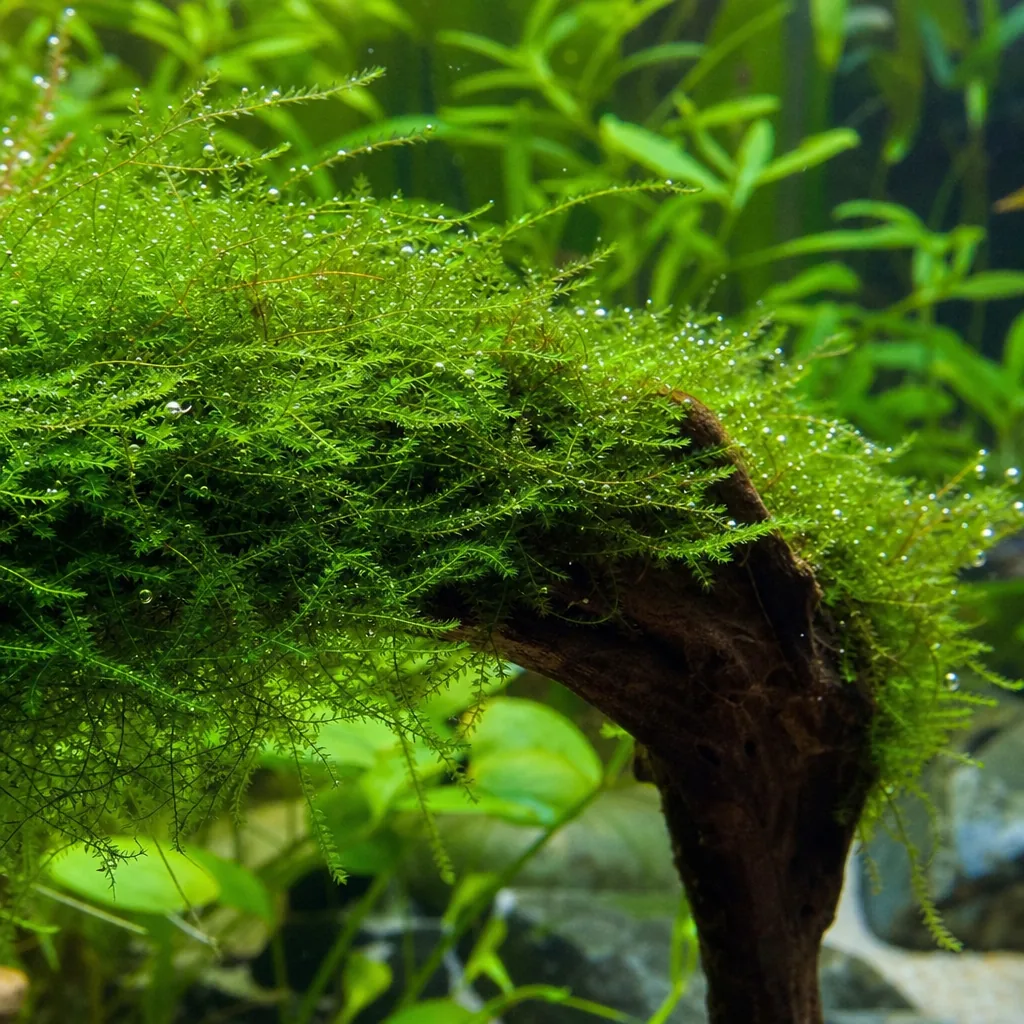
Java fern is a true fern from Southeast Asia that grows along streams, often clinging to wet rocks and roots with part of the plant out of the water. In aquariums it has become a go-to plant for beginners, low-light tanks and tanks with plant-eating fish, because its tough leaves contain compounds that most fish find unpleasant to eat.
A plant that doesn’t belong in the gravel
Java fern doesn’t take nutrients through deep roots. It spreads along a creeping stem called a rhizome, with fine dark roots that grab onto surfaces. Push that rhizome down into gravel or sand and it suffocates and rots. The fix is simple: grow it on hardscape instead.
Attaching java fern
- Driftwood. The most natural look. Tie the rhizome against the wood with cotton thread, which rots away on its own after the roots take hold.
- Lava rock or slate. Rough rock gives the roots more to grip. Fishing line or a rubber band works here too.
- Glue. Aquarium-safe cyanoacrylate gel holds it in seconds. Use a small amount on the rhizome only.
- Gaps in rockwork. Tuck the rhizome loosely between stones so the leaves rise above.
Within a few weeks, the roots usually wrap the surface well enough that you can cut away any line.
Light and water
Java fern grows in low to medium light, so a basic aquarium LED is enough. Strong light often turns the leaves pale or brown and invites algae on the slow-growing leaves. It does well in:
- Temperature: about 68 to 82°F (20 to 28°C)
- pH: about 6.0 to 7.5
- Hardness: soft to moderate
It’s a good fit for cooler tanks, including goldfish setups, as long as the fish don’t uproot it. CO2 isn’t required. A weekly dose of a general liquid fertilizer helps keep leaves dark green, as the plant draws nutrients from the water.
Popular varieties
- Standard java fern: long, broad leaves, up to about 12 inches.
- Narrow leaf: slimmer, tall leaves that look good in the background.
- Windelov: leaf tips split into fine, lacy branches.
- Trident: narrow leaves with several side lobes, a more delicate look.
- Needle leaf and mini varieties: compact forms for nano tanks or foregrounds.
Brown spots and black patches
Two different things get mistaken for each other:
Raised brown or black bumps in neat rows on the underside of mature leaves are normal reproductive structures. They’re where the fern grows new plantlets, and they’re not a disease.
Soft, translucent or spreading black patches, often called java fern melt, are a sign of stress. Common causes are a buried rhizome, a sudden change in conditions, too much light, or a lack of nutrients, especially potassium. Trim affected leaves, check that the rhizome is in open water, and begin regular fertilizer if you don’t use one already.
How java fern reproduces
Older leaves often grow tiny new plants, with their own roots and leaves, along the edges or tips. Once the babies have a few leaves and roots of their own, you can pull them free and attach them elsewhere, or leave them to form a dense bush. You can also cut the rhizome into sections with several leaves each. This is the cheapest way to fill out a tank over time.
Maintenance
Trim old, damaged or algae-covered leaves at the base near the rhizome. Gently wipe the leaves if dust or algae builds up. Because java fern grows slowly, it rarely needs heavy pruning. Every year or so, you may want to divide an oversized clump to keep it in proportion.
Where java fern fits
Java fern works in the background or on midground wood. It pairs naturally with anubias, which has similar needs, and with mosses on the same hardscape. It’s a strong choice for betta tanks and shrimp tanks, and you’ll find it on our lists of low-light plants and plants for bettas.
Setting up a java fern tank
Because java fern doesn’t need substrate, it opens up layouts that are hard with rooted plants. You can grow a full green tank on bare-bottom or sand with only wood and stone, which makes cleaning easy. A popular approach is to tie several plants along a branch of spiderwood or manzanita, so the leaves form a canopy that shades shy fish. Another is to pack small varieties like Windelov or Trident into gaps in dragon stone for a natural stream look. Place the pieces before filling, if you can, so you can arrange the leaves while they’re easy to see. Keep in mind that a mature fern can spread to a foot or more across, so leave space between plants for them to fill in.
Choosing a variety for your tank
Several cultivated forms of java fern are sold, and they differ mainly in leaf shape and final size. The standard form has long, narrow, slightly wavy leaves and suits the middle or back of most tanks. Narrow leaf and needle leaf types have thinner blades and a lighter, grassy look. Windelov, often called lace java fern, has forked tips that give the leaves a frilly edge. Trident has deeply lobed leaves and stays fairly compact, which makes it a good fit for nano tanks and tight rockwork. Larger forms can reach a height that crowds a small aquarium, so check the expected size on the label before you buy and match it to the spot you have in mind.
When you pick plants at a store or unpack an order, look for a firm green rhizome and leaves without large clear or black patches. A few brown spots on older leaves are not a reason to pass, because the plant will replace them. Rinse the plant in dechlorinated water and remove any rock wool or plastic pot before attaching it. If the plant came from a tank with snails, a short look under the leaves for eggs can save you a pest problem later.
Feeding a slow grower
Because java fern grows slowly and has no deep roots, it draws most of its nutrients from the water column. In a tank with fish and regular feeding, waste often supplies much of what it needs. If new leaves come in pale, small, or yellow between the veins, a weekly dose of a complete liquid fertilizer usually helps. Root tabs do little for a plant that is tied to wood. Go easy with dosing in low light. Extra nutrients that the plant cannot use tend to feed algae instead, and algae on the slow leaves is hard to remove without damage.
Plantlets, spores and propagation
Java fern reproduces in two ways you will notice in an aquarium. Small plantlets form on the leaves, often at the tips or on older blades, complete with their own tiny roots. Once a plantlet has a few leaves and roots of its own, you can pull it free gently and tie it to a new surface, or let it drift until it settles somewhere. The other method is dividing the rhizome. Use clean scissors to cut a long rhizome into sections, making sure each piece keeps several leaves. The dark rows of bumps under mature leaves are spore structures (sori), not a disease, and they do not need to be removed.
Bottom line
Attach java fern to wood or rock, keep the rhizome out of the substrate, give it gentle light and a simple liquid fertilizer, and let plantlets spread it over time. For a full beginner-friendly plant lineup, see the best aquarium plants for beginners or visit the AquaticRig shop.
Java fern helpers: java fern, spider wood for mounting, and API Leaf Zone for the occasional liquid feed.
Frequently Asked Questions
Can java fern float?
It can survive floating for a while, but it grows better and looks neater when attached to something. Floating ferns tend to drift into the filter intake.
Why are my java fern leaves turning brown?
Light brown leaves often mean too much light or not enough nutrients. Black, soft patches usually point to a buried rhizome or stress. Neat rows of dark bumps underneath are normal.
Will goldfish eat java fern?
Usually not. Its leaves are tough and taste unpleasant to most fish, which is why it’s popular in goldfish and cichlid tanks.
How fast does java fern grow?
Slowly. Expect a new leaf every week or two in a typical low-tech tank, a little faster with good fertilizer and CO2.
This article was researched and written with AI assistance and reviewed for accuracy.