
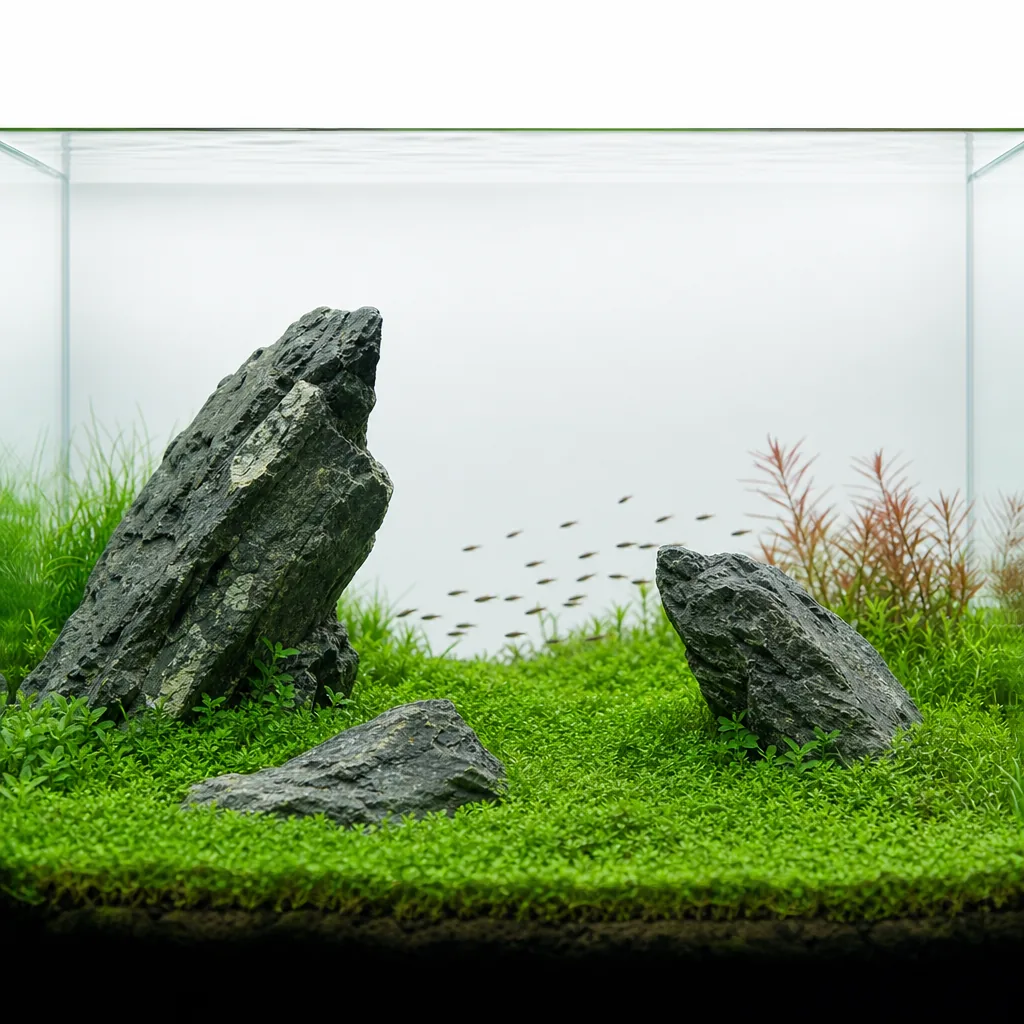
An Iwagumi tank looks effortless: a few stones, a green carpet, open water. That simplicity is a trap. With nothing to hide behind, every mistake in stone placement, carpet health, or algae control shows immediately. This is the style that teaches restraint, and it is far harder to pull off than a busy planted jungle.
The Origin and Idea Behind Iwagumi
Iwagumi is a Japanese term meaning “rock formation,” and the style was refined and popularized by the late aquascaper Takashi Amano. It draws on Japanese garden principles: balance, simplicity, and the beauty of empty space. The goal is not to fill the tank but to create a calm, natural-feeling scene from the fewest possible elements.
Where Dutch style is a dense garden, Iwagumi is a landscape reduced to its essentials. Stones stand in for mountains or hills, a low carpet for a grassy field, and the open water above for sky. The discipline is knowing what to leave out.
The Rule of Odd Numbers
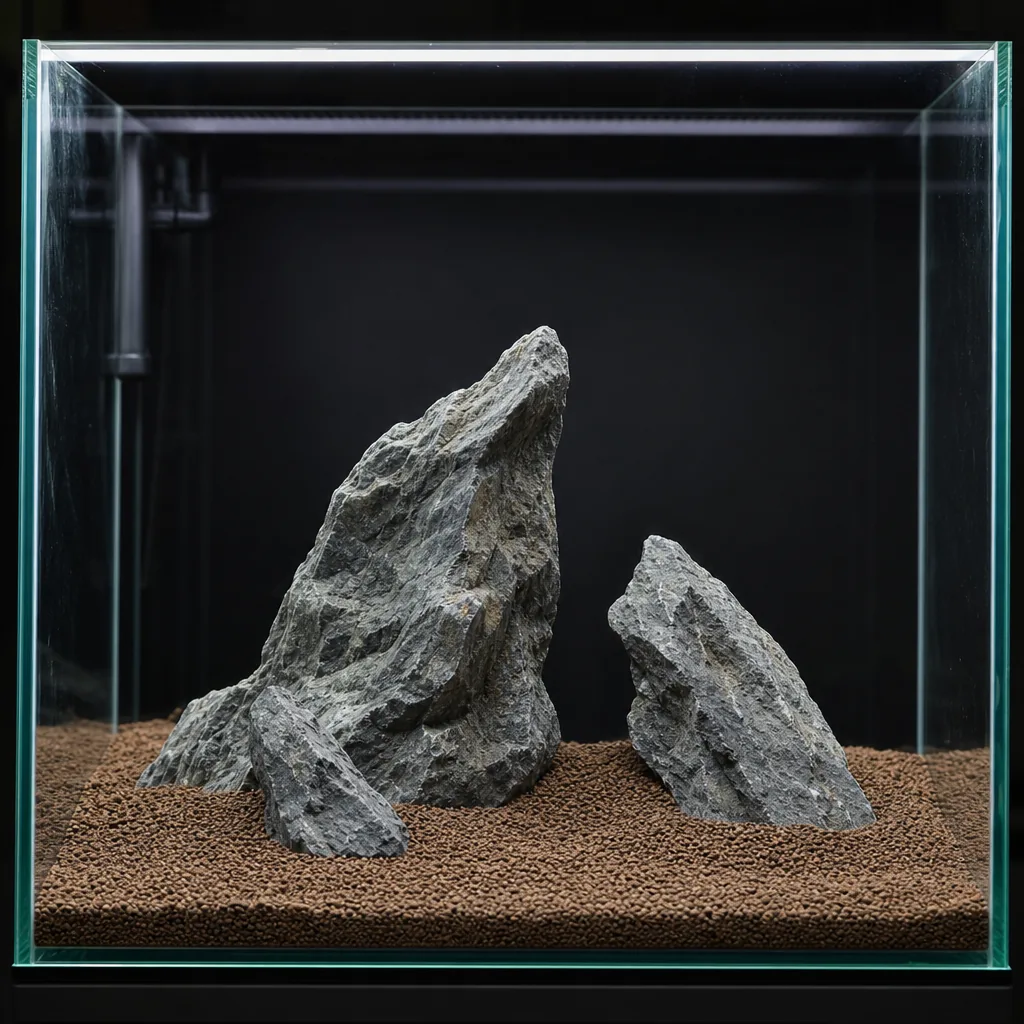
The foundational Iwagumi convention is to use an odd number of stones, most commonly three, five, or seven. Odd numbers avoid the static, mirror-image symmetry that even numbers create and keep the composition feeling natural and dynamic. A single dominant stone paired with smaller supporters is the classic building block.
You generally use one type of stone throughout the layout so the scene reads as a single, coherent formation rather than a collection of unrelated rocks. Consistent color, texture, and grain matter as much as the shapes.
The Named Stone Roles
Traditional Iwagumi assigns each stone a role, and understanding them helps you compose deliberately rather than just piling rocks.
- Oyaishi – the main stone. The largest and most striking, it is the visual anchor and is usually placed slightly off-center, tilted to suggest the flow of water or wind.
- Fukuishi – the secondary stone. The second largest, it supports and balances the Oyaishi, often placed on the opposite side.
- Soeishi – the accent stones. Smaller supporting rocks that reinforce the main formation.
- Suteishi – the “sacrificial” or throwaway stone. A small, humble rock that adds naturalness without drawing attention. It often sits partly hidden by the carpet.
Placement and the Golden Ratio
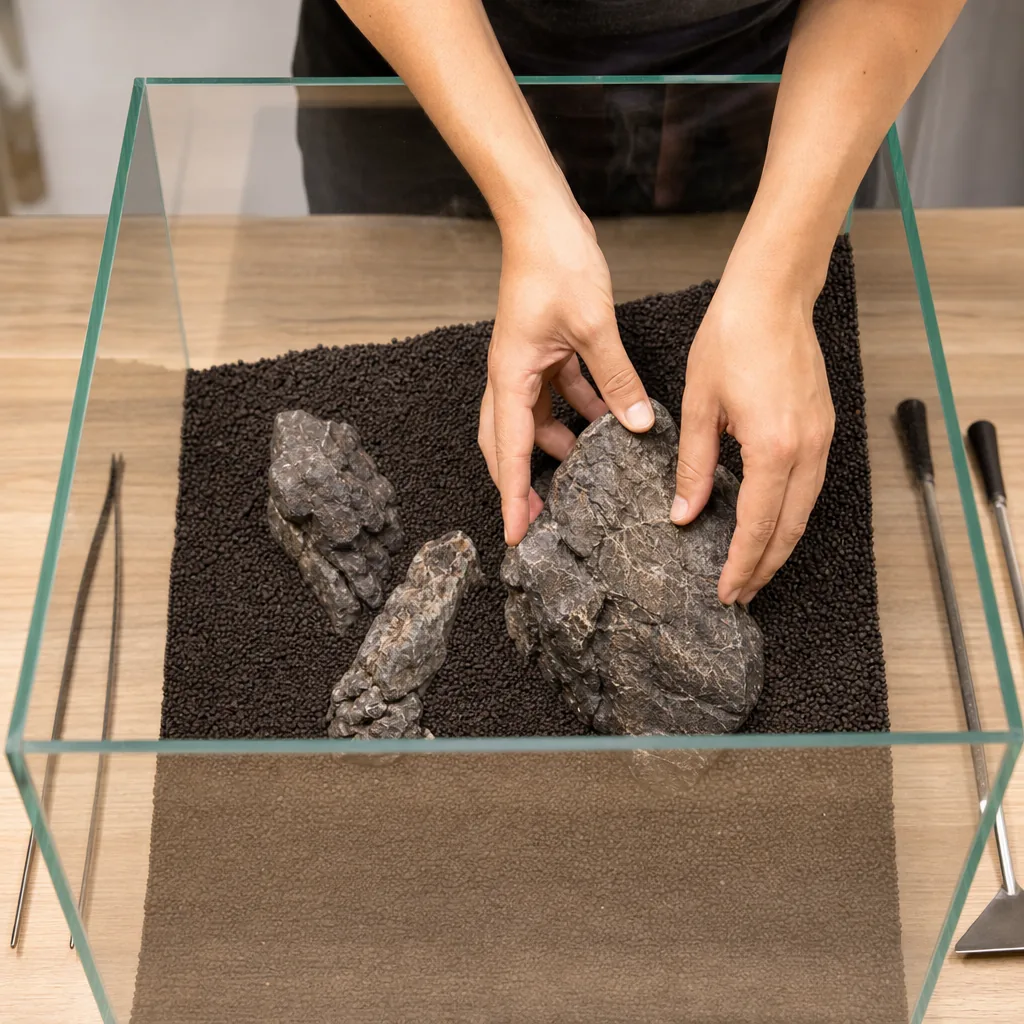
The main stone rarely sits dead center. Instead, aquascapers place the Oyaishi at roughly a golden-ratio point, about two-thirds of the way across the tank, to create tension and interest. Tilt the stones consistently so they all appear shaped by the same force, like rocks in a riverbed leaning with the current.
Bury the bases of the stones into the substrate so they look like they emerge from the earth rather than sitting on top of it. Slope the substrate higher toward the back to add depth. Step back frequently and view the tank from the front and from a distance, because Iwagumi is judged as a whole composition, not stone by stone.
Plants: Less Is the Point
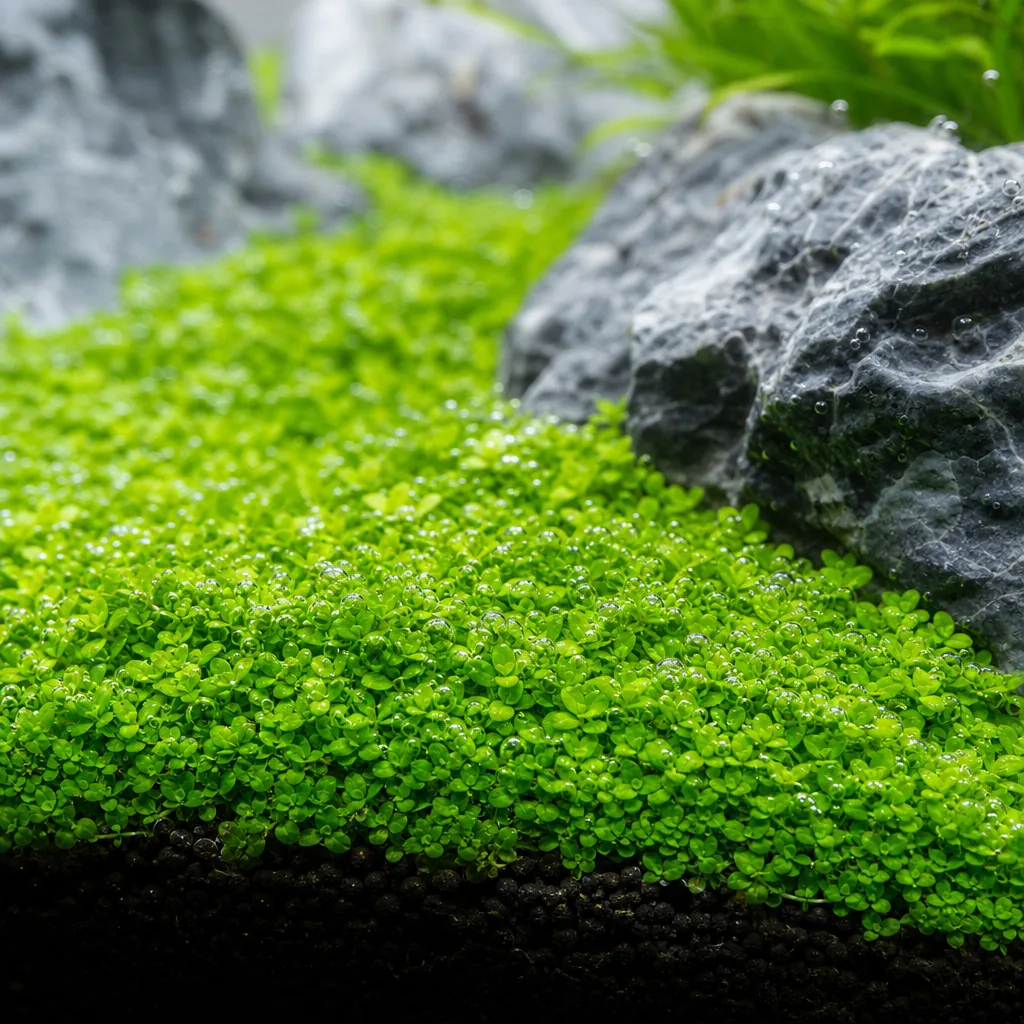
Iwagumi typically uses just one or two low carpeting plant species so the stones stay the stars. A uniform green carpet across the foreground is the signature. Common choices are short, spreading species that form a dense turf. Some layouts add a small amount of a second low plant for subtle texture, but the restraint is deliberate.
Because the plant palette is so limited, the health and evenness of that single carpet is everything. Patchy or algae-covered carpet ruins an Iwagumi in a way it would not ruin a busy Dutch tank. For carpeting options and lighting to support them, see the shop and our freshwater care guides.
The Hard Part: Algae and Stability
Here is the honest challenge with Iwagumi. A carpet needs strong light and CO2 to grow low and dense, and strong light over sparse planting is a recipe for algae. Early on, before the carpet fills in, there is a lot of open substrate and stone surface for algae to colonize, and not much plant mass competing for nutrients.
The way through is patience and stability: get CO2 dialed in and consistent, keep the photoperiod modest at first, do frequent water changes during the startup weeks, and consider algae-eating livestock once the tank matures. A tightly run dosing routine helps too; the Estimative Index approach on our blog is one option, though many carpeters run leaner. Do not add a lot of light before you have plant mass to use it.
Livestock for an Iwagumi
The clean, open water of an Iwagumi is best shown off by a single species of small schooling fish moving together. A tight school of small tetras or rasboras adds life and motion without cluttering the scene, and the uniform look echoes the style’s simplicity. Small shrimp are excellent for grazing algae off the stones and carpet. Resist the urge to add many different fish; a single well-chosen species fits the aesthetic far better than a mixed community.
Iwagumi rewards planning and punishes haste. Spend real time on the stone placement before you add a single plant, because once the carpet grows in you cannot rework the layout without tearing it down. Get the stones right, be patient through the algae-prone startup, and the payoff is one of the most serene scenes in the hobby.
Frequently Asked Questions
Why do Iwagumi tanks use an odd number of stones?
Odd numbers, usually three, five, or seven, avoid the static symmetry that even numbers create and keep the composition natural and dynamic. A single dominant stone with smaller supporters is the classic arrangement.
What are the stone roles in Iwagumi?
The main stone is the Oyaishi, the secondary is the Fukuishi, smaller accents are Soeishi, and the small humble throwaway stone is the Suteishi. Each has a place in balancing the formation.
Should I use different kinds of rock in an Iwagumi?
No. Use one type of stone with consistent color, texture, and grain so the layout reads as a single coherent formation rather than a random pile of rocks.
Why does my Iwagumi get so much algae?
The style pairs strong light and CO2 with sparse planting, so early on there is little plant mass to compete with algae. Keep the photoperiod modest, get CO2 stable, do frequent water changes at startup, and add grazers as the carpet fills in.
What fish suit an Iwagumi tank?
A single species of small schooling fish, such as small tetras or rasboras, complements the clean minimalist look. Small shrimp are also great for grazing algae off the stones and carpet.