
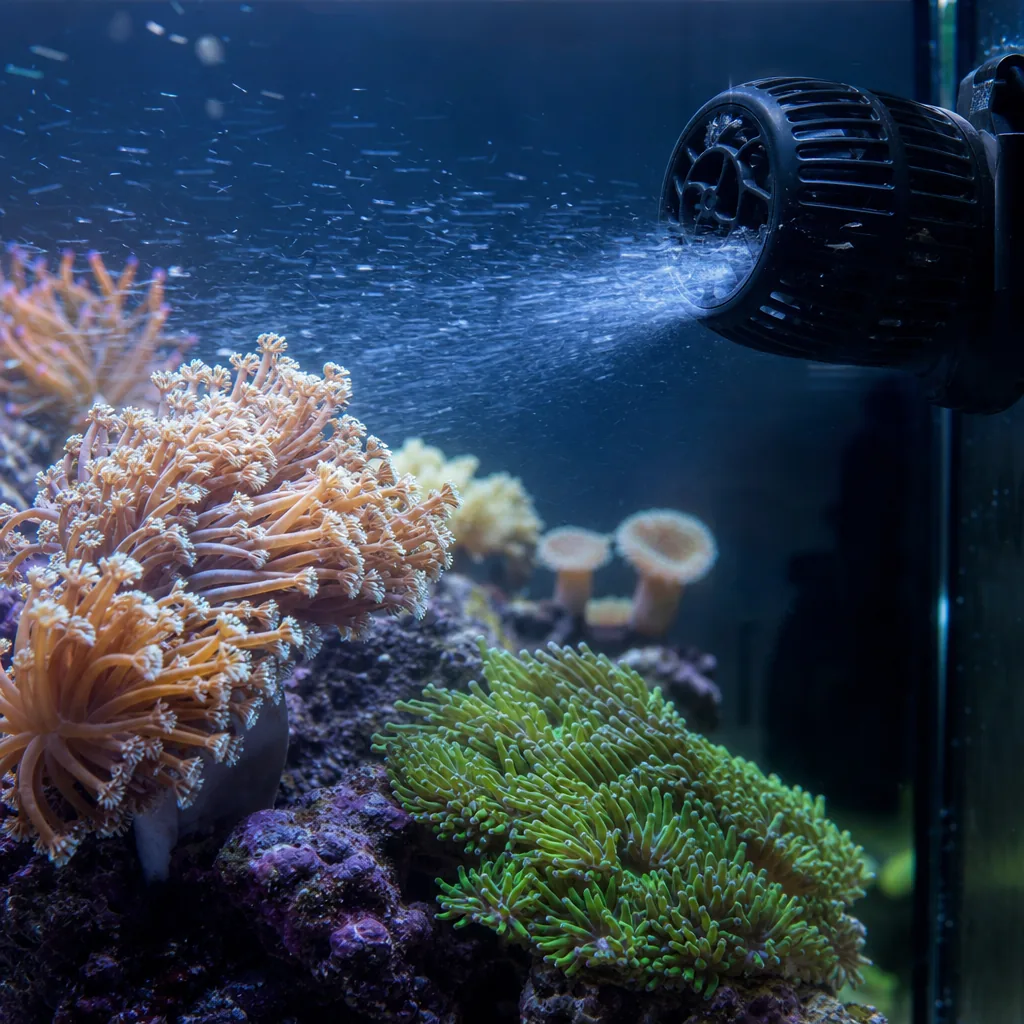
Corals can’t move to find food or shed waste, so the water has to do it for them. Flow brings food and oxygen, carries away waste, and helps keep detritus suspended so the skimmer and filter can remove it. A powerhead (also called a wavemaker) is the main tool for creating that movement in a reef tank.
How much flow do you need?
Flow is often described as turnover, the number of times the tank’s volume passes through pumps each hour. Rough targets reef keepers use:
- Soft corals and mushrooms: about 10 to 20 times tank volume per hour
- Mixed reefs with LPS: about 20 to 40 times
- SPS-dominant tanks: often 40 times or more
For a 50-gallon mixed reef, that means somewhere around 1,000 to 2,000 gallons per hour of total powerhead flow. Return pump flow counts a little, but most of the movement comes from powerheads. Manufacturer flow ratings are usually measured under ideal conditions, so real numbers are somewhat lower.
Turnover is a guide, not a rule. The type of flow and where it goes matter as much as the number.
Propeller vs gyre pumps
Propeller pumps push a cone-shaped stream from a round nozzle. They’re compact, come in many sizes, and are easy to aim. The narrow stream can be strong close to the pump, so keep corals out of the direct jet.
Gyre or cross-flow pumps push a wide, flat sheet of water across the tank. They’re excellent at moving the whole water column and reduce dead spots, especially in long tanks. They’re bulkier and work best mounted along the back or side glass.
Both can work well. Many reefers use two smaller pumps instead of one large one, placed so their flows meet and break up into random movement.
Controllable DC pumps
Most modern reef powerheads use DC motors with a controller. That gives you:
- Adjustable speed, so you can tune flow to your corals rather than buying a smaller pump
- Wave modes like random, pulse or reef crest that vary strength over time
- Night mode for lower flow when the lights are off
- Feed mode, which pauses or slows the pump so food can settle
Older AC pumps run at one speed only. They’re cheaper but less flexible, and they’re often louder.
Placement
A few rules make placement easier:
- Point flow across the tank, not straight at corals or rockwork faces at close range.
- Aim at least one pump to sweep the sand bed and the back of the rockwork, where detritus collects.
- Avoid blasting the surface so hard that water splashes out, but some ripple helps gas exchange.
- Keep pumps away from the overflow so they don’t push surface water away from it.
Watch your corals for feedback. Polyps that stay retracted, or tissue that’s being whipped hard, suggests too much direct flow. Detritus piling up in one corner, or coral polyps that never sway, suggests too little.
Mounting and noise
Most powerheads attach with a magnet mount through the glass. Check the glass thickness rating, because a mount sized for thin glass can slip on a thick aquarium. Mounting the pump slightly away from the glass and using the rubber pads cuts vibration noise. In a bedroom or living room, quieter DC pumps are well worth the extra cost.
Maintenance
Coralline algae and calcium deposits build up on propellers and housings over time, which reduces flow and adds noise. Every few months, soak the pump parts in a diluted vinegar or citric acid solution, scrub, and rinse well before reinstalling. Check propellers and shafts for wear at the same time.
Snails and small fish sometimes get stuck in intake grills, so a foam guard over the intake is worth adding, especially with a fresh pump.
Matching flow to your corals
Soft corals like leathers and zoanthids like moderate, varied movement. LPS corals with fleshy polyps, such as hammers and torches, can tear in strong flow, so place them in gentler spots. SPS corals generally appreciate strong, random flow. Our list of beginner corals includes notes on placement, and if colors are fading, our guide on corals losing color covers flow among the causes.
Sizing examples
To put the numbers in context, here’s how flow plans often look in practice. A 20-gallon nano reef with soft corals might use one small controllable pump around 400 to 800 GPH, run at partial power. A 75-gallon mixed reef could use two pumps of 1,000 to 2,000 GPH each on opposite sides, with one set slightly stronger so the flows collide and swirl. A 120-gallon SPS tank often runs a pair of gyre pumps along the back glass, or two to four propeller pumps, for several thousand gallons per hour of total movement. Buying a pump a size larger than you need and turning it down is usually smarter than buying one that’s maxed out, since pumps run quieter and last longer below their top speed.
Final thoughts
Size total powerhead flow to the corals you keep, choose a controllable pump if your budget allows, and aim for gentle, varied movement across the whole tank. Check our reef lighting guide next, or browse pumps in the AquaticRig shop.
Powerheads on AquaticRig: Hydor Koralia Nano 565, AI Nero 3, Jebao SOW-15 and the hygger 1600 GPH wavemaker. More on the pumps and air page.
Frequently Asked Questions
Can a powerhead be too strong?
Yes. Too much direct flow can stop polyps from opening and damage soft tissue. That’s why controllable pumps are popular. You can turn the strength down instead of replacing the pump.
Do I need two powerheads?
Not always, but two medium pumps usually give more natural, random flow than one large pump, and they leave you with flow if one fails.
Should powerheads run at night?
Yes, at a lower setting. Corals still need flow at night, but many reefers lower it to mimic calmer conditions and reduce noise.
Can a powerhead replace a return pump?
No. A return pump moves water from the sump back to the display. Powerheads move water within the display tank. Most reefs use both.