
 Hover to zoom


API 5-in-1 Test Strips
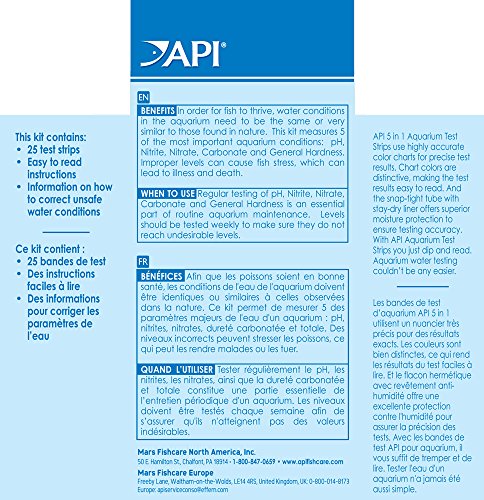
Dip-and-read strips that check pH, nitrite, nitrate, carbonate hardness and general hardness in fresh or saltwater tanks.
- Checks pH, nitrite, nitrate, KH and GH from one strip
- For freshwater and saltwater aquariums
- Dip, wait and match colors to the chart
- Suited to weekly checks and spot checks when problems appear
- Also sold in 4-count and 100-count boxes
Check the latest price and availability on Amazon.
View on Amazon →As an Amazon Associate, AquaticRig earns from qualifying purchases.
Pros
- Five readings in one dip
- Fast enough for weekly routine checks
- Works for fresh and saltwater tanks
Cons
- No ammonia reading
- Less precise than liquid test kits
- Strips spoil if moisture gets into the container
At a glance
Dip-and-read strips that check pH, nitrite, nitrate, carbonate hardness and general hardness in fresh or saltwater tanks.
A quick, easy weekly check for fresh or saltwater tanks.
- Checks pH, nitrite, nitrate, KH and GH from one strip
- For freshwater and saltwater aquariums
- Dip, wait and match colors to the chart
- Suited to weekly checks and spot checks when problems appear
- Also sold in 4-count and 100-count boxes
Product Specifications
- Brand
- API
- Model
- 33G
- Size
- 25-Count
- Measures
- pH, nitrite, nitrate, KH, GH
- Water type
- Freshwater and saltwater
- Dimensions
- 3.5 x 1.75 x 6.5 inches
- Weight
- 0.1 pounds
- Other sizes
- 4-count (33H), 100-count (33P)
API 5-in-1 Test Strips give you a quick read on five water values from a single strip: pH, nitrite, nitrate, carbonate hardness (KH) and general hardness (GH). You dip a strip in tank water, wait, and compare the pads to the color chart on the box. API makes them for both freshwater and saltwater aquariums.
What the five readings tell you
- pH. Shows whether the water is acidic or alkaline. Sudden swings matter more than the exact number.
- Nitrite. Should read zero in a cycled tank. Any nitrite usually means the biofilter is still building or has been disturbed.
- Nitrate. Builds up between water changes. A rising number is your cue to change more water or feed less.
- KH. Carbonate hardness buffers pH. Low KH lets pH crash.
- GH. General hardness, which matters for fish and shrimp that prefer soft or hard water.
What it doesn’t measure
There is no ammonia pad on this strip. In a new tank, or after fish deaths, you’ll want ammonia too. A liquid kit such as the API Freshwater Master Test Kit covers ammonia and gives finer readings. Reef keepers also need alkalinity, calcium and salinity tests that strips don’t replace, like the Salifert alkalinity kit.
Getting a reliable reading
Use dry hands and close the container right after taking a strip, since moisture can ruin the rest. Hold the strip still in the water for the time given in the directions, then read it in good daylight. Compare all five pads before the colors keep changing. API suggests weekly checks, plus extra checks whenever the water looks off or fish act strangely.
Box sizes
This page covers the 25-count box. The same strips also come in a 4-count box, handy as a trial or an emergency spare, and a 100-count box for keepers with several tanks. The strips and readings are the same in every size.
Who should look elsewhere
If you need precise numbers to chase a problem, or you’re cycling a tank and need ammonia, a liquid kit is the better tool. Strips are best as a fast weekly check.
The Bottom Line
A quick, easy weekly check for fresh or saltwater tanks. Pair it with an ammonia test, and switch to a liquid kit when you need precise numbers.
View on Amazon →As an Amazon Associate, AquaticRig earns from qualifying purchases.
Frequently Asked Questions
Do these strips test ammonia?
No. The five readings are pH, nitrite, nitrate, KH and GH. Use a separate ammonia test.
Can I use them in a saltwater tank?
Yes. API makes these strips for both freshwater and saltwater aquariums.
Which box size should I buy?
The 25-count box suits one tank with weekly checks. The 100-count box suits several tanks, and the 4-count box works as a spare.