
 Hover to zoom



Seachem Flourish Tabs
Root fertilizer tablets you push into the gravel to feed rooted aquarium plants for months.
- Root fertilizer tablets for aquarium plants
- Contains iron, manganese, magnesium, calcium and potassium
- One tab per 4 to 6 inch radius; 6 for a 10 gallon tank
- Replace every three to four months
- Available in 10-tab and 40-tab packs
Check the latest price and availability on Amazon.
View on Amazon →As an Amazon Associate, AquaticRig earns from qualifying purchases.
Pros
- Feeds root-heavy plants directly
- Long-lasting, so little upkeep
- Won't change pH, per Seachem
Cons
- Of little use for java fern, anubias or floating plants
- Unburied tabs can feed algae
At a glance
Root fertilizer tablets you push into the gravel to feed rooted aquarium plants for months.
A simple, long-lasting way to feed swords, crypts and other root feeders in gravel.
- Root fertilizer tablets for aquarium plants
- Contains iron, manganese, magnesium, calcium and potassium
- One tab per 4 to 6 inch radius; 6 for a 10 gallon tank
- Replace every three to four months
- Available in 10-tab and 40-tab packs
Product Specifications
- Brand
- Seachem
- Model
- 67105050 (10 ct), 18799 (40 ct)
- Size
- 10 tabs
- Dose
- 1 tab per 4-6 inch radius; 6 tabs for a 10 gallon tank
- Replace
- Every 3 to 4 months
- Water type
- Freshwater planted tanks
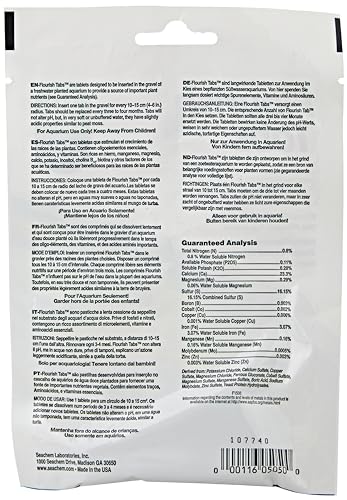
Seachem Flourish Tabs are fertilizer tablets for the roots of aquarium plants. You push them into the gravel near the plants, and they release nutrients slowly into the root zone. Seachem lists iron, manganese, magnesium, calcium and potassium, plus trace elements, amino acids and vitamins.
Which plants benefit
Heavy root feeders get the most from tabs. Amazon swords, cryptocorynes and vallisneria take most of their food through their roots, so a liquid fertilizer alone can leave them short. If you keep an Amazon sword or Cryptocoryne wendtii in plain gravel, root tabs make a visible difference. Plants that grow on wood or rock, like java fern and anubias, don’t use them.
How many to use
- One tab for every 4 to 6 inch (10 to 15 cm) radius of substrate.
- Seachem says a standard 10 gallon tank takes 6 tabs.
- Push each tab about halfway into the gravel bed, spread evenly or next to heavy feeders.
- Add new tabs every three to four months.
Effect on water
Seachem says the tabs won’t change pH. In very soft or unbuffered water they act slightly acidic, a bit like peat. Bury them fully, since a tab left on the surface releases nutrients into the water and can feed algae.
Pack sizes
This page leads with the 10-tab pack, enough for one setup of a 10 gallon tank plus a few spares. The 40-tab pack suits larger tanks or several refills.
Who should look elsewhere
If you’ve set up on a nutrient-rich soil like Fluval Stratum, you may not need tabs for the first months. Tanks of mostly stem or floating plants are better served by a liquid fertilizer.
The Bottom Line
A simple, long-lasting way to feed swords, crypts and other root feeders in gravel. Bury them fully and refresh every few months.
View on Amazon →As an Amazon Associate, AquaticRig earns from qualifying purchases.
Frequently Asked Questions
How many tabs does a 10 gallon tank need?
Seachem says 6 tabs for a standard 10 gallon aquarium.
How often do I replace them?
Every three to four months.
Will they change my pH?
Seachem says no, though in very soft, unbuffered water they act slightly acidic.